Science fiction lasts when it does more than predict gadgets or decorate a story with futuristic scenery.
The books that endure usually carry something larger inside them. They ask what power does to people. What technology changes and what it cannot change. What happens when belief, control, survival, identity, and ambition are pushed past the familiar world. The setting may be distant, but the pressure is often very close to home.
That is one reason the strongest science fiction classics continue to matter. They are not only artifacts of genre history. They are books that still provoke thought, still shape newer work, and still reward readers willing to meet them on their own terms.
Some are vast and political. Some are philosophical. Some are compact and sharp. Some are strange enough to be disorienting at first. That is part of the point. Science fiction at its best enlarges the frame. It gives writers room to test ideas at full scale and gives readers room to see familiar human problems from another angle.
A few classics remain central for good reason.
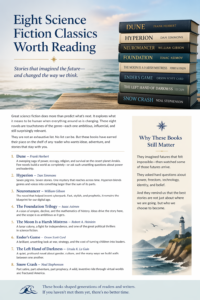
Dune endures because it is not just a story of power on a desert planet. It is also a novel about ecology, manipulation, leadership, myth, and the danger of what people are willing to worship.
Hyperion remains memorable for its structure as much as its imagery. Its layered voices and shifting forms let it operate as mystery, pilgrimage, tragedy, and speculative vision all at once.
Neuromancer still matters because it helped shape the language and atmosphere of digital modernity before much of it arrived. Its influence can be felt far beyond the novel itself.
The Foundation Trilogy continues to draw readers because of its scale and its confidence in ideas. It is less interested in psychological intimacy than in the movement of systems, institutions, and long historical pressures.
The Moon Is a Harsh Mistress remains compelling because it brings political argument, rebellion, and practical ingenuity into the foreground without losing narrative force.
Ender’s Game still works because it is lean, tense, and emotionally direct. Beneath its tactical brilliance sits a story about isolation, pressure, manipulation, and moral cost.
The Left Hand of Darkness endures for a different reason. Its power comes from patience, atmosphere, cultural depth, and the way it asks readers to reconsider the assumptions they bring to sex, society, and human relationship.
Snow Crash holds its place through sheer energy, wit, and imaginative force. It is excessive in places, but deliberately so. Its speed and inventiveness helped shape how later readers and writers imagined virtual worlds and fractured modern culture.
These books are not all doing the same kind of work. That is part of what makes the field so durable. Science fiction is broad enough to hold epic worldbuilding, political theory, literary structure, social criticism, noir, satire, and metaphysical speculation. A reader may prefer one strain over another, but the classics remind us that the genre has always had range.
Not every classic will suit every reader. Some ask for patience. Some arrive with unfamiliar language or dated assumptions. Some feel more influential than lovable. That is true of many older books in every genre. Even so, influence is not the only reason to read them. The best of them are still alive on the page. They still carry tension, atmosphere, and argument. They still leave marks.
At Seaford Shores Publishing, we care about books with staying power. Science fiction classics earn their place when they continue to challenge, unsettle, or enlarge the reader long after the novelty of their setting has worn off.
That is what makes them classics in the first place.
Not that they were first. Not that they were famous.
That they still matter.